Speech at the Commemoration by the Memorial Plaque
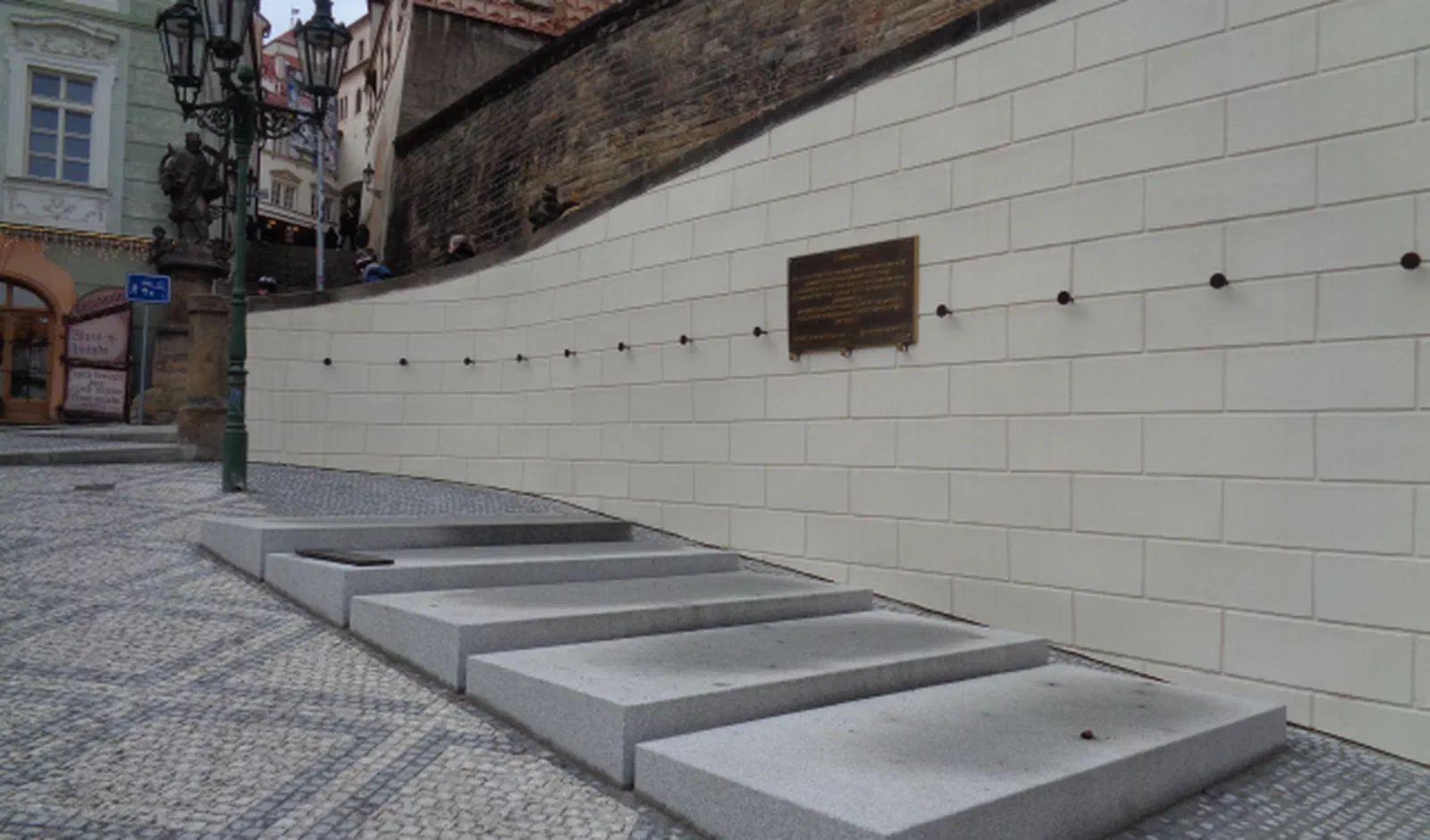
Ladies and gentlemen, this year, for the first time, we can remember the students’ march for freedom and democracy together in newly renovated surroundings. Less than a metre in front of me, you can read the new dedication on the bronze plaque: “To the students who did not bow their heads and did not succumb to the lie.”
And it was indeed university and secondary-school students who, on 25 February, did not bow their heads and set out for the Castle – heads held high, without hats and without rifles, unlike the communist militiamen marching back and forth across Prague. These students did not succumb to the lies of communist propaganda, unlike the jubilant rank-and-file comrades welcoming Gottwald, who had just returned victorious from the Castle. Unlike Gottwald, the students never reached President Beneš at the Castle on 25 February – it was right here that their march was brutally broken up by the communist police.
Just as at the symbolic beginning of communist totalitarianism on 25 February 1948, so at its symbolic end on 17 November 1989 we find a brutally dispersed student march. In both cases the students marched for freedom and democracy, albeit in very different social climates. Still, allow me a brief comparison. The February march of 1948 ended in political purges at universities – one student in four was expelled, more than 10,000 in total; most of the expelled students ended up in the Auxiliary Technical Battalions (PTP), through which some 60,000 inconvenient citizens passed; other expelled students, after political show trials, joined the political prisoners mining uranium – more than 4,500 political prisoners did not survive the inhumane conditions of the camps and prisons. Why did the February march end like this, while the November march of 1989 ended with Václav Havel at the Castle and free elections?
The key difference, as I see it, was the reaction of the silent majority – ordinary people who do not concern themselves with politics in ordinary times. While in 1948 they stayed at home alone with their fear – and we must admit that the fear was justified – in 1989 they took to the streets because of the beaten students. Many students of 1948 perhaps secretly hoped for exactly this awakening of the silent majority through President Beneš; they hoped it would turn out after all that the mass of communist militiamen, trade unionists and shock workers, though numerous and loud, was still only a minority. They hoped for it as the last chance to save freedom and democracy, after all the pillars of democracy had already fallen one by one.
These five granite blocks, these five symbolic steps towards freedom, represent for me the five key pillars for preserving freedom and democracy.
The first pillar, free competition among democratic parties, we lost on the road to February as early as 1945, with the creation of the National Front.
The second pillar, sovereign and independent state administration, we lost soon afterwards, when orders in our “liberated” state came from the Soviet embassy and Soviet secret services abducted and murdered Czechoslovak citizens with the tacit knowledge of the Czechoslovak government.
The third pillar, independent institutions, we lost gradually through a combination of political vetting and the placing of communists in all key organs of state power – from the gendarmerie and the army, through the trade unions and political parties, to the secret services and key state enterprises.
The fourth pillar, freedom of speech and of the press, was first systematically bombarded by communist propaganda, and not only from Rudé právo, before turning, during the February crisis, to hard censorship and the liquidation of the non-communist press.
And the fifth pillar is the lesson that evil cannot be appeased, nor can one strike a gentleman’s agreement with it, as the democrats vainly tried to do with the Communist Party after the Second World War. The democratic parties’ retreat from the stage, in the form of the ill-considered resignation of their ministers, opened the door for Gottwald to seize all power. And with the final concession – when President Beneš gave in to Gottwald’s pressure and accepted the resignations of the democratic ministers – he signed democracy’s death notice for a long 41 years. And perhaps at the very moment when the ill and abandoned President Beneš sat down to sign the resignations, the first students were gathering on Charles Square to march to the Castle.
By 25 February 1948 it was already too late to save freedom and democracy. But when is the right time to take to the streets? What state are these five pillars of democracy in now? Let us reflect on that as we climb Nerudova Street towards the Castle.
In closing, allow me to thank those who made the renovation of this space possible: Petr Konvalinka, former rector of the Czech Technical University, who, after seeing the state of the site before the renovation, initiated a student seminar on architectural solutions for it; Atelier KAVA, which designed the present dignified layout; and Prague 1, which secured and completed its realisation. Nor can I forget the leadership of the Senate of the Czech Republic and our long-standing cooperation dating back to the installation of the memorial plaque in 2003. I believe that just as this space now lets the plaque stand out, reminding us of what happened here 71 years ago, so our gathering today will help spread awareness of the students’ march to the Castle in the public sphere.
Thank you for your attention.
25 February 2019, Nerudova Street,
Chair of PAK 48,
Martin Špolc