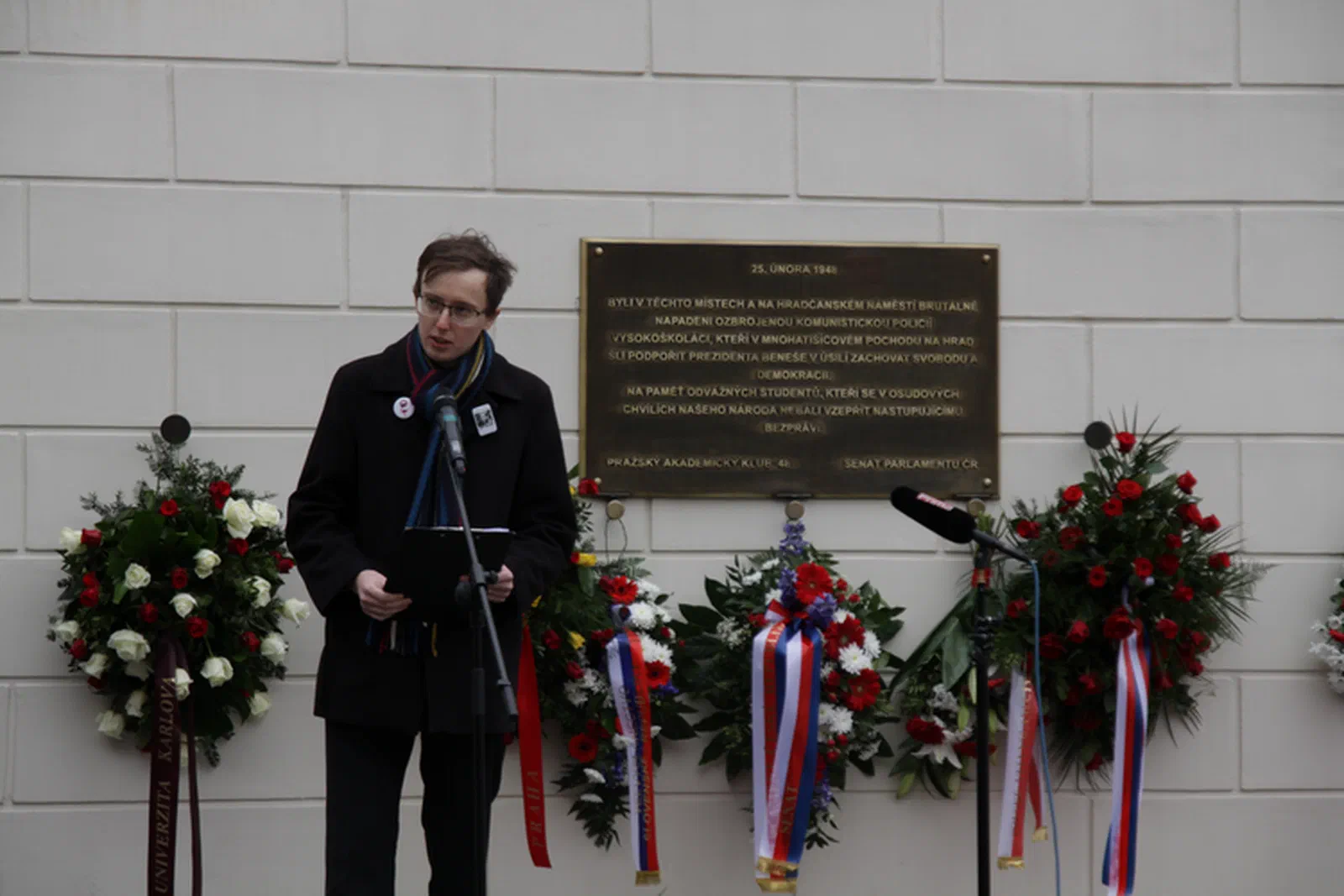
Speech at the Commemoration by the Memorial Plaque
Ladies and gentlemen,
when we gathered here last year, I briefly recalled how post-war Czechoslovakia was transformed into a communist dictatorship. On their way to February, the communists destroyed free competition among democratic parties, took control of the state administration and key institutions, and trampled on freedom of speech and of the press. The violent suppression, here in Nerudova Street 72 years ago, of what would be the last mass student demonstration for a long time was merely the final symbolic full stop on the communists’ road to absolute power.
This year, allow me to recall the events that immediately preceded the students’ march for freedom and democracy in February 1948, as well as those that followed – with consequences not only for its participants. Already in the early morning of 23 February, Štěpán Plaček, head of domestic intelligence of the State Security, issued a short order: “On suspicion of anti-state activity, arrest the following persons immediately”, followed by a list of 12 people, including leading figures of student life.
The list included, for example, the journalist Pavel Tigrid, who by a stroke of luck was abroad and so escaped arrest. Emil Ransdorf, a law student, chairman of the Union of University Students and head of the Všehrd law students’ association, also avoided arrest; under dramatic circumstances he even managed to take the Všehrd banner with him into exile. Others on the warrant were not so lucky. Felix Uhl, a medical student and chairman of the Association of Czech Medical Students, was arrested and sentenced to 20 years in a show trial. Nor did Pavel Pták, a student at the Czech Technical University and chairman of the Association of Commercial Engineering, escape arrest, or Ludvík Reiman, secretary to Vladimír Krajina, general secretary of the National Socialists. Another person on the list, the People’s Party MP Rostislav Sochorec, met an even more tragic fate. After his arrest and interrogation in Prague he was taken to a psychiatric hospital in Brno, where he died in mysterious circumstances on 13 May 1948 – less than three months after the February march.
The students who took part in the marches to the Castle on 23 and 25 February knew that their leaders had been arrested, yet they were not afraid to stand up for freedom and democracy. On 24 February some two thousand students even demonstrated right under the windows of the Communist Party secretariat by the Powder Tower, chanting: Release the jailed students and don’t come at us with bayonets!
The communists’ revenge came almost immediately. So-called action committees, made up mainly of communist students, began expelling their non-communist classmates – as early as 25 February, 12 students were expelled from the Faculty of Law of Charles University. Immediately after 25 February several hundred students were expelled: the action committees went after the leaders of faculty associations and of the People’s Party and National Socialist academic clubs, and of course after students they learned had taken part in the march.
Many students who were unwilling to accept the new communist order and the atmosphere of fear chose emigration and left the universities – between 25 February and the end of 1948 some 3,000 students left Czechoslovakia. Those who stayed often prolonged their time at university by only a few months. In January 1949 a mass political purge took place at the universities, unparalleled even in the neighbouring communist countries. Every student had to fill in a lengthy questionnaire in which their communist colleagues asked what income and property they had, what they owned, how much their parents earned and which organisations they belonged to. The communists disguised the purge as a “study review”, yet students with a Party card and poor grades were spared, while their non-communist classmates with good grades but a bad political profile were expelled. During January and February 1949 more than 9,000 students were expelled.
In total, during the first year of totalitarian rule the communists got rid of more than 12,000 students. For comparison, the Nazi closure of the universities on 17 November 1939 ended the studies of 15,000 students. The political purge of the universities was, sadly, only the beginning of a regime that lasted more than four decades, during which the communists denied education to young people with a “bad political profile” and offered everyone else an education wrapped in Marxist-Leninist propaganda.
Let us pause and try to imagine where our society would be today had we not driven into exile and trampled into the ground hundreds of thousands of talented young people who wanted to contribute to the development of our country.
Thank you for your attention.
25 February 2020, Nerudova Street,
Chair of PAK 48,
Martin Špolc